Eng


“The beautiful women of Ittire wear a scarlet cloth skirt with very fine pleats and two gold braids at the hem… The continuous, resonant jingle of the twenty-two silver buttons adorning their sleeves leaves a delightful impression.”
Enrico Costa, 1876

The Sardinian writer Enrico Costa, too, was captivated by the richness and beauty of the Ittiri
costume, which jingled merrily thanks to the exquisite ‘button placket’
.“‘Sa Buttonera’ is, in fact, the distinctive feature of the traditional costume of the village of Ittiri, in Northern Sardinia.
The 22 buttons (or often 20) made of silver filigree are the marvellous jewels that make up ‘Sa Buttonera’.
The pomegranate-shaped buttons adorn the forearms of the jacket, divided between each side. Only two are threaded through the buttonholes, whilst the others hang down and jingle with every movement of the wearer.
Their size and weight have increased significantly over time, due to fierce competition amongst families; the total weight can reach as much as 2 kg!
In the early 20th century, a very small number of wealthy families also began using gold buttoneras as a further sign of distinction.

Almost all teenage girls in Ittiri families – who were mainly engaged in agriculture, sheep farming or small-scale craftwork – had their own festive dress: the red dress, worn for weddings and important occasions.

‘Su estire ruju’ is the dress we can admire during the traditional parades in Ittiri or at events in Sardegna.
The fabrics are of high quality, the colours are vibrant, the ornamentation elaborate and the finishing touches meticulous.
The apron (pannellu ‘e tullu) of the ‘bestire ruju’ is normally made of white tulle embroidered with floral motifs or with vine leaves and bunches of grapes, in chain stitch, white on white.
The stiff bodice (imbustu), worn with a small breast-covering scarf usually made of tulle, lace or light-coloured silk, is almost always covered in white satin, embroidered with roses and leaves using multicoloured silk threads and gold thread.

The bolero (su corittu) is usually made of smooth silk velvet in shades of red or purple and is also decorated with the characteristic twisted silk cords.
The garment features eye-catching slits at the forearms, floral embroidery near the elbow, and is further embellished with silver-coloured metal sequins (lustrinos).
The headdress for the gala costume consists of a baggy bonnet (iscoffia), made of brocade until 1930 and subsequently almost always of embroidered white satin, over which a white tulle veil (tullu or velu) is draped, matching the apron. The ‘estire ruju’ is never worn without a lavish array of jewellery, strictly prescribed by tradition.

Discover all the Salude & Trigu events where you can admire the traditional costumes of the Sardegna.

Explore the culture and nature of Northern Sardinia: places to discover, local dishes, traditions and stories from the region.


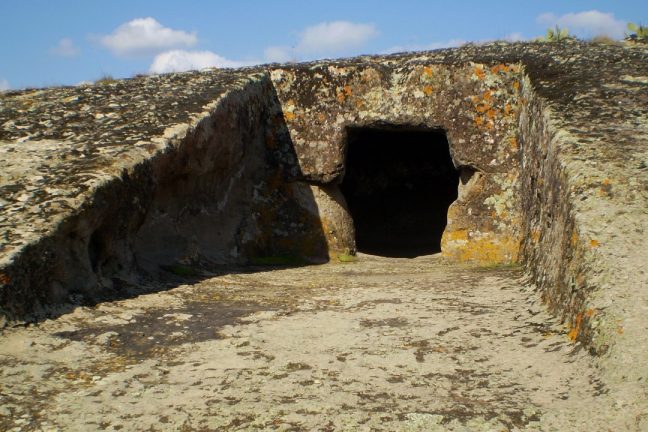
‘Domus de Janas’ is a Sardinian expression meaning ‘house of the fairies’. Legends tell of beings that are not particularly spiritual – demons, somewhere between human and divine.

Sardegna has a wine-making tradition stretching back thousands of years; the earliest evidence of wine-making dates as far back as 1400 BC.

There is a story linked to the island of Tavolara which tells that King Carlo Alberto of Savoy appointed his only son as king of the island.

The Ludurru necropolis is situated in Buddusò, and the domus de janas date back to 3200–2800 BC, famous examples of the Sardegna Neolithic period

The Neptune Caves are spectacular caves dating back to prehistoric times. They are located at Alghero, in Northern Sardinia

The Church of St Francis in Alghero is one of the finest examples of Catalan Gothic architecture in Sardegna