Eng


In Luogosanto, in the historic region of Gallura, there is a gem of history and architecture intimately linked to the events of the Sardegna Giudicale period.
It is the ancient Palazzo di Baldu, an evocative fortress nestled in a dense holm oak forest, situated in the hamlet of Santo Stefano, a few kilometres from the town centre. It formed part of the Villa di Sent Steva, a medieval settlement that has since disappeared but which is first recorded in the 16th century, belonging to the curatoria of Balayana.
The palace, comprising sixteen rooms surrounded by a vast courtyard, served as the administrative and bureaucratic heart of the Villa di Sent Steva, but it was more than that. It was the residence of judges and a place where life was certainly lively and well-organised. Studies carried out by the Archaeological Superintendency for the provinces of Sassari and Nuoro have demonstrated the presence on site of storehouses, kitchens, stables and even workshops.
Today, of the palace’s remains, we can admire the quadrangular layout, with a sloping plinth and a terrace featuring an external staircase. The perimeter walls are clearly visible, soaring skywards and opening up a passageway through the foliage of the holm oak grove.

Every self-respecting castle has its ghost, and Baldu’s Palace is no exception.
Legend has it that the ghost of Ubaldo II Visconti, a prominent historical figure who lived during the Kingdom of Gallura, haunts its walls and rooms. He held the office of judge of Gallura from 1225 until his death and was buried, in accordance with tradition, in the Basilica of Our Lady of Luogosanto.
Husband of Adelasia of Torres, the last ruling judge of Torres, Ubaldo II inherited the Giudicato of Gallura at the tender age of 18. Among his great achievements was the invasion of the Giudicato of Cagliari, carried out to secure Pisan influence in the southern Sardegna.
It is said that the construction of Palazzo di Baldu was a tribute to the birth of Judge Visconti. It is no coincidence that the name of the Gallura manor is said to derive precisely from the historical figure of Ubaldo.

Explore the culture and nature of Northern Sardinia: places to discover, local dishes, traditions and stories from the region.


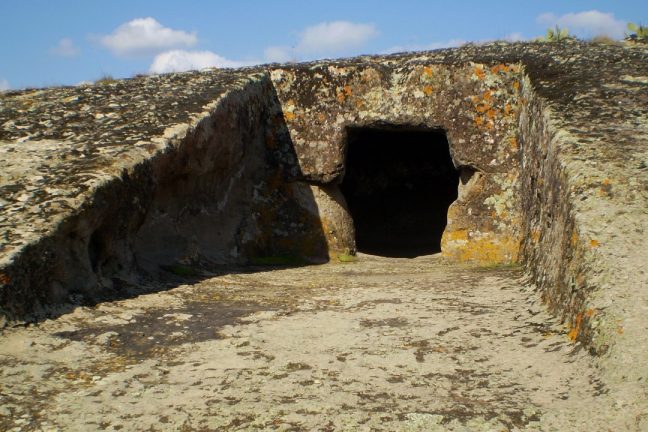
‘Domus de Janas’ is a Sardinian expression meaning ‘house of the fairies’. Legends tell of beings that are not particularly spiritual – demons, somewhere between human and divine.

Sardegna has a wine-making tradition stretching back thousands of years; the earliest evidence of wine-making dates as far back as 1400 BC.

There is a story linked to the island of Tavolara which tells that King Carlo Alberto of Savoy appointed his only son as king of the island.

The Ludurru necropolis is situated in Buddusò, and the domus de janas date back to 3200–2800 BC, famous examples of the Sardegna Neolithic period

The Neptune Caves are spectacular caves dating back to prehistoric times. They are located at Alghero, in Northern Sardinia

The Church of St Francis in Alghero is one of the finest examples of Catalan Gothic architecture in Sardegna