Eng


Halloween has now won the hearts of many Italians, and in Sardegna too, 31 October is a day to celebrate this fun event that has come over from Anglo-Saxon countries.
But perhaps not everyone knows that in Sardegna there is a deeply cherished festival that is very reminiscent of Halloween, yet has very ancient and entirely local origins.
In Sardegna, the month of November is known as Sant’Andria, a saint whose feast day is on the 30th.
Traditionally, the whole month of November was dedicated to the god Dionysus, also known as Bacchus, the Greek god of the vine, wine and mystical ecstasy.
On the evening of 30 November, in some villages of Anglona, masked men would go out carrying grates, knives and axes; by clanging these weapons together, they would make a great din to frighten the children. The origin of this tradition is said to stem from two episodes relating to the myth of Dionysus
.
“It is said that Zeus, to protect Dionysus from Hera’s attacks, took him to a cave on Mount Ida and entrusted him to the Curates, who stood guard over him; to drown out his cries, they danced around the child, clanging their weapons together to make a noise.
The other episode, however, concerns the capture of the infant Dionysus by the Titans, who tore him to pieces, then boiled and roasted his flesh. This would explain the type of weapons and grills carried by the men to frighten the children.” (Source: Martis Town Council website)
Sant’Andrìa is a fascinating tradition reminiscent of Halloween, but with deeply Sardinian roots. There are many differences, starting with the date:
on 30 November each year, in Martis, the town’s young people take part in this unique custom: they hollow out pumpkins and carve them to resemble frightening human faces; finally, they light them with candles.
These young people knock on the doors of houses with their lit pumpkins and announce their arrival armed with lids and ladles, reciting this ancient rhyme:
“Sant’Andria, cut off your hands! Can you spin the yarn?
One, two, three –
cut off your hands and feet!
St Andrew, chop off their hands! Have you spun enough yarn?
Four and three – I’ll chop off
your hands and feet!
St Andrew, chop off their hands! Have you spun enough yarn?
Four and eight – I won’t touch
your hands!”
It is said, in fact, that Saint Andrew rewards the girls who have spun the most and punishes the lazy ones, threatening to cut off their hands for not having worked hard enough!
In return for this performance, the young people are given traditional sweets such as papassini, sweets, dried fruit and money.
In Bono, too, Saint Andrew’s Day is celebrated every 30 November. Following a tradition handed down from generation to generation, the village’s young people gather in groups from early in the morning to collect pumpkins. Once these pumpkins have been emptied of their seeds and carefully carved to resemble human and monstrous figures, they are lit from within by candles.
As dusk falls, the young people begin to walk through the village streets with the pumpkins hanging round their necks, knocking on the doors of houses. Accompanied by shouts of ‘Sant’Andrìa’ and the jingle of bells, they collect donations, including traditional sweets such as ‘passassini’ and ‘tilicche’, walnuts, sweets and monetary contributions.
Su Trinta 'e Sant’Andria is a special occasion celebrating the traditional tapping of new wines, traditionally held on the last Saturday in November. The wine cellars in the historic centre are opened to the public, offering tastings of new wines and local food and drink products.
Every year, this event attracts thousands of visitors who celebrate in the streets of the centre of one of the most beautiful and charming towns in Logudoro. Sant’Andrìa becomes a special occasion for socialising and sampling traditional produce.

To honour the dead, during the month of November – dedicated to commemorating the departed – Sardinian families also prepare traditional sweets known as Papassini. In particular, as well as during Sant’Andrìa and throughout the month of November, these delicious sweets are offered to children, along with bread, nuts, fruit and sweets, on 2 November – All Souls’ Day – when in many Sardinian towns and villages you can see countless children knocking on doors, shouting “Mortu Mortu” or “Is Animas”.
The name ‘papassini’
, or ‘papassinos’
, derives from the presence of sultanas, known in Sardinian as ‘pabassa
’.
In short, the festival of Sant’Andrìa is a fascinating journey into the customs and deep-rooted beliefs of Sardegna, rooted in the past yet still alive and vibrant in contemporary culture. And November is a wonderful month to discover the region of Northern Sardinia and its traditions.

Explore the culture and nature of Northern Sardinia: places to discover, local dishes, traditions and stories from the region.


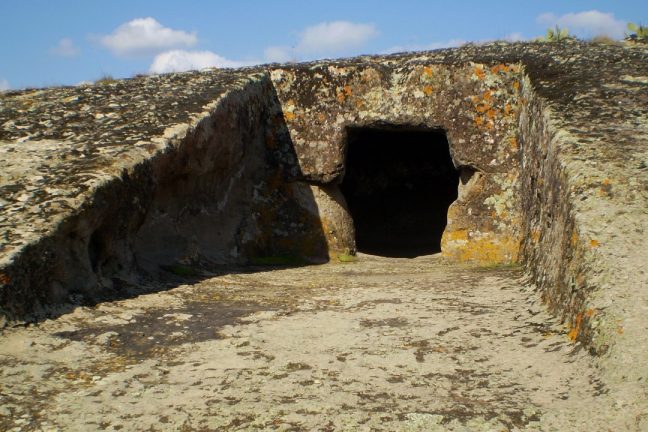
‘Domus de Janas’ is a Sardinian expression meaning ‘house of the fairies’. Legends tell of beings that are not particularly spiritual – demons, somewhere between human and divine.

Sardegna has a wine-making tradition stretching back thousands of years; the earliest evidence of wine-making dates as far back as 1400 BC.

There is a story linked to the island of Tavolara which tells that King Carlo Alberto of Savoy appointed his only son as king of the island.

The Ludurru necropolis is situated in Buddusò, and the domus de janas date back to 3200–2800 BC, famous examples of the Sardegna Neolithic period

The Neptune Caves are spectacular caves dating back to prehistoric times. They are located at Alghero, in Northern Sardinia

The Church of St Francis in Alghero is one of the finest examples of Catalan Gothic architecture in Sardegna