Eng


The Northern Sardinia is teeming with splendid churches, basilicas and abbeys.
In the municipality of Ittiri lies one of the most evocative: the Abbey of Our Lady of Paulis, dating back to the Middle Ages and once home to Cistercian monks.
Its ancient ruins are set within a pleasant landscape of incredible beauty, amongst rolling hills and rocky outcrops.
Today, Salude&Trigu takes you on a journey to discover the history of the abbey, the Ittiri area and the legends that surround the building.
Built around 1200, the Abbey of Our Lady of Paulis in Ittiri
remained active with its monastic community for millennia.
It was built thanks to a donation by King Comita II of Torres to the
monks of the Cistercian Benedictine Order
, and was inhabited by monks until the late Middle Ages (around 1400).
The walls
, still clearly visible around the perimeter, are made of limestone
and reflect the architectural style typical of the Cistercian craftsmen working on the island at the time.
Today, Ittiri Abbey stands as a striking ruin that leaves room for the imagination
, bringing to life the
evocative atmosphere of medieval monasteries
.
Around the building, one can admire remains of the cloister and the convent’s rooms
, both attached to the abbey and situated a short distance from the main building.
The abbey’s layout was
in the form of a cross-in-saint-John’s-cross
, comprising three naves
divided by arches supported by pillars. The transept housed the apse and two chapels
, situated on the right and left respectively.
The Abbey of Our Lady of Paulis
stands in a magical natural setting. It is surrounded by green hills
and sedimentary rock
formations, which are often found in the landscapes of Northern Sardinia.
It lies along the route of an ancient Roman road
known as ‘s’istrada de sos
Padres’, meaning ‘the monks’ road’
, as it linked the Abbey of Ittiri
with that of Santa Maria di Corte, in Sindia.
The name ‘Paulis’, on the other hand, referring to the abbey, derives from that of the marshy area in which it was built, known as Paludis or Padulis
.
A fascinating legend
surrounds the abbey. It is said that the monks
who lived there practised magic and alchemy
. Thus, over the centuries, a story spread that immense riches
lay hidden within the monastery.
Like other such tales
, the legend attracted numerous ‘treasure hunters’
, yet none of them ever found any treasure in the abbey. From this story, however, another, equally fascinating legend arose.
According to popular belief, the ghosts of the monks
who remained to guard the infamous treasure – said to have been kept in the cellars – still roam the walls of Our Lady of Paulis, in Ittiri.
Some legends, as we know, have their roots in historical reality. Indeed, Father Piero Cau
lived in the abbey; everyone called him ‘su padre biancu’ (the white monk)
because of the colour of his habit. Father Cau was murdered in 1958 and, after a lengthy search, was found at the bottom of a well.
One story gives rise to another, and so, even today, it is said that Father Cau is still there, as a ghost, protecting the abbey’s treasures.

Explore the culture and nature of Northern Sardinia: places to discover, local dishes, traditions and stories from the region.


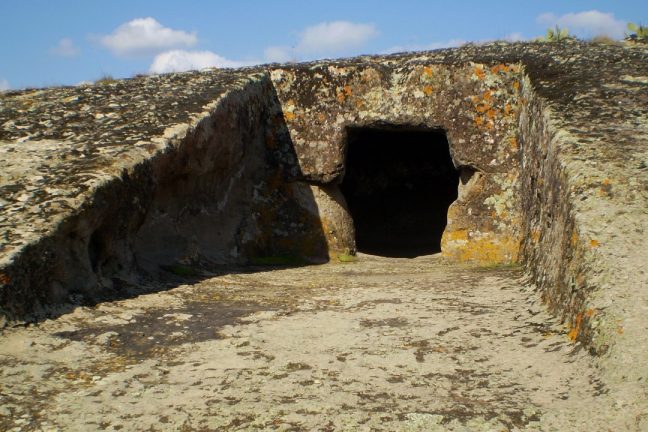
‘Domus de Janas’ is a Sardinian expression meaning ‘house of the fairies’. Legends tell of beings that are not particularly spiritual – demons, somewhere between human and divine.

Sardegna has a wine-making tradition stretching back thousands of years; the earliest evidence of wine-making dates as far back as 1400 BC.

There is a story linked to the island of Tavolara which tells that King Carlo Alberto of Savoy appointed his only son as king of the island.

The Ludurru necropolis is situated in Buddusò, and the domus de janas date back to 3200–2800 BC, famous examples of the Sardegna Neolithic period

The Neptune Caves are spectacular caves dating back to prehistoric times. They are located at Alghero, in Northern Sardinia

The Church of St Francis in Alghero is one of the finest examples of Catalan Gothic architecture in Sardegna